
Two different quantities
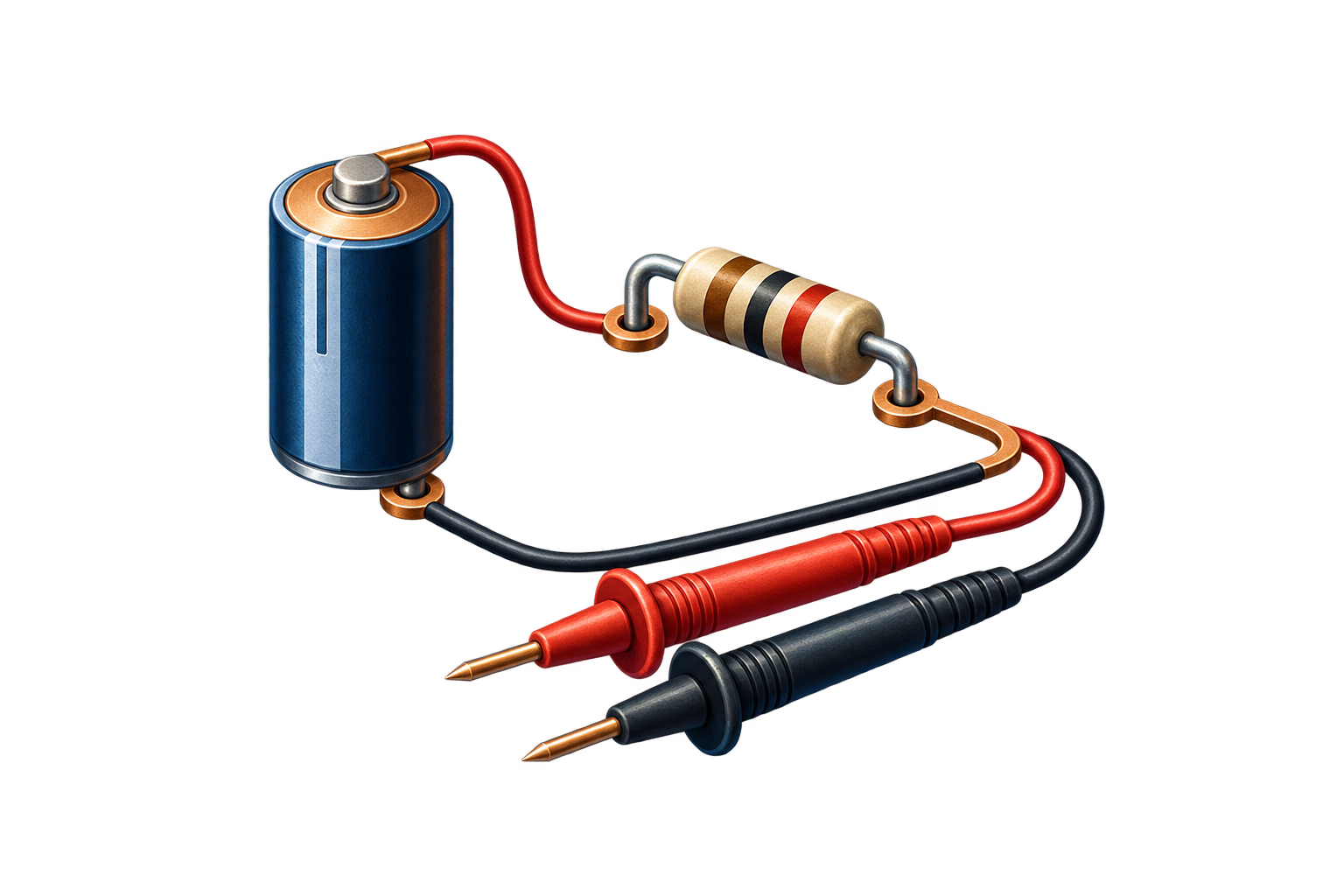
Voltage is the difference in electric potential between two points. It is measured in volts (V). A 5 V supply maintains a 5 V potential difference between its terminals; voltage is always measured between points, not at an isolated point.
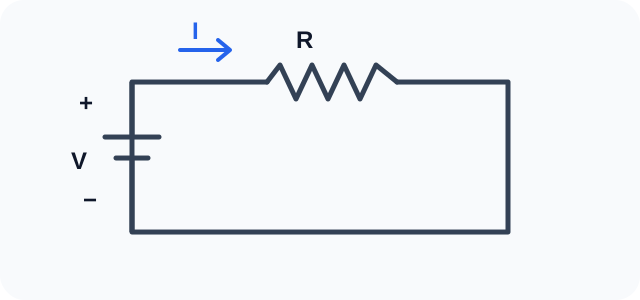
Current is the rate at which electric charge passes through a conductor. It is measured in amperes (A), where 1 A means 1 coulomb of charge per second. Conventional current points from the positive terminal through the load toward the negative terminal.
What happens in a closed circuit?
The source establishes a voltage across the load. If there is a complete path, charge flows through the load. Opening the path stops the steady current, even though the source may still have voltage across its terminals.
Voltage and current describe different properties of the same circuit. A voltage value alone does not tell you the current: the load also matters. The next lesson introduces the relationship for a resistor.
Measuring them
Place a voltmeter in parallel with the two points whose potential difference you want to know. Place an ammeter in series so the measured current passes through it. Never connect an ammeter directly across a voltage source: its low internal resistance can cause a dangerous short circuit.
Worked example
If a current of 20 mA flows for 5 s, the charge that passes is Q = I × t = 0.020 A × 5 s = 0.10 C. Convert milliamperes to amperes before calculating.
Before continuing, check that you can explain why a voltmeter connects across a component while an ammeter connects in the current path.