
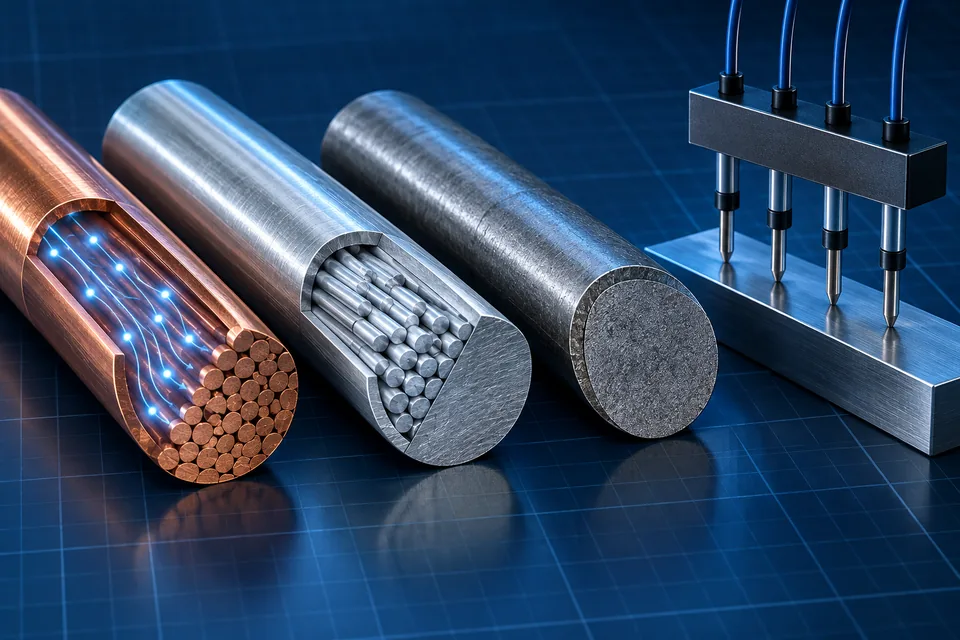
Electrical resistivity
Resistivity, conductivity, temperature coefficient and typical values for conductive materials at 20°C.
Written and technically reviewed byElectroDesignForge Engineering Team
View the editorial process📖 Definition
Electrical resistivity (ρ, rho) is a fundamental property that quantifies how strongly a material opposes the flow of electric current.
A low resistivity indicates an excellent electrical conductor, while a high resistivity characterizes an insulating or resistive material.
Quick Reference
| Property | Value |
|---|---|
| Symbol | ρ (rho) |
| SI Unit | Ω·m |
| Inverse Property | Conductivity (σ) |
| Reference Temperature | 20°C |
| Main Formula | R = ρL / A |
Typical Electrical Properties of Conductive Materials
| Material | IACS (%) | Resistivity (Ω·m @20°C) | Conductivity (MS/m) | Temp. Coefficient α (1/°C) |
|---|---|---|---|---|
| Silver | 106 | 1.59 × 10⁻⁸ | 62.9 | 0.00380 |
| Copper (Annealed) | 100 | 1.724 × 10⁻⁸ | 58.0 | 0.00393 |
| Copper (OFHC) | 101 | 1.71 × 10⁻⁸ | 58.5 | 0.00390 |
| Gold | 70 | 2.44 × 10⁻⁸ | 41.0 | 0.00340 |
| Aluminium | 61 | 2.82 × 10⁻⁸ | 35.5 | 0.00429 |
| Tungsten | 31 | 5.60 × 10⁻⁸ | 17.9 | 0.00450 |
| Zinc | 29 | 5.90 × 10⁻⁸ | 16.9 | 0.00370 |
| Nickel | 25 | 6.99 × 10⁻⁸ | 14.3 | 0.00600 |
| Brass* | 23–28 | (6–8) × 10⁻⁸ | 15–17 | 0.00150 |
| Bronze* | 12–18 | (9–14) × 10⁻⁸ | 7–11 | 0.00180 |
| Iron | 17 | 9.71 × 10⁻⁸ | 10.3 | 0.00500 |
| Tin | 15 | 1.09 × 10⁻⁷ | 9.2 | 0.00450 |
| Platinum | 16 | 1.06 × 10⁻⁷ | 9.4 | 0.00392 |
| Lead | 8 | 2.20 × 10⁻⁷ | 4.8 | 0.00400 |
| Stainless Steel (304) | 2.5 | 7.20 × 10⁻⁷ | 1.39 | 0.00094 |
Notes
- IACS = International Annealed Copper Standard.
- All values are typical values measured at 20°C.
Resistivity Formula
The resistance of a conductor depends on its geometry and the resistivity of the material.
          ρ × L
R = ─────────────────
            A
Where:
| Symbol | Description | Unit |
|---|---|---|
| R | Electrical resistance | Ω |
| ρ | Electrical resistivity | Ω·m |
| L | Conductor length | m |
| A | Cross-sectional area | m² |
Conductivity
Electrical conductivity is the inverse of resistivity.
σ = 1 / ρ
| Symbol | Description | Unit |
|---|---|---|
| σ | Electrical conductivity | S/m |
| ρ | Electrical resistivity | Ω·m |
Temperature Dependence
For most metallic conductors, resistivity increases almost linearly with temperature.
ρ(T)=ρ₀[1+α(T−T₀)]
Where:
| Symbol | Description |
|---|---|
| ρ(T) | Resistivity at temperature T |
| ρ₀ | Resistivity at reference temperature |
| α | Temperature coefficient |
| T | Operating temperature |
| T₀ | Reference temperature |
Practical Example
Consider a copper conductor with:
- Length: 10 m
- Cross-sectional area: 1 mm²
- Resistivity: 1.724 × 10⁻⁸ Ω·m
Using:
          ρ × L
R = ─────────────────
            A
The calculated resistance is approximately:
R ≈ 0.172 Ω
Why is copper preferred over silver?
Although silver has the highest electrical conductivity of any metal, its significantly higher cost limits its use to specialized applications such as RF connectors, microwave components and high-performance electrical contacts. Copper provides nearly the same electrical performance at a fraction of the cost, making it the industry standard.
Bibliography
- IEC 60287 — Electric Cables
- IPC-2152 — Standard for Determining Current-Carrying Capacity in Printed Board Design
- ASTM B193 — Electrical Resistivity of Conductors
- NIST Electrical Properties Database