
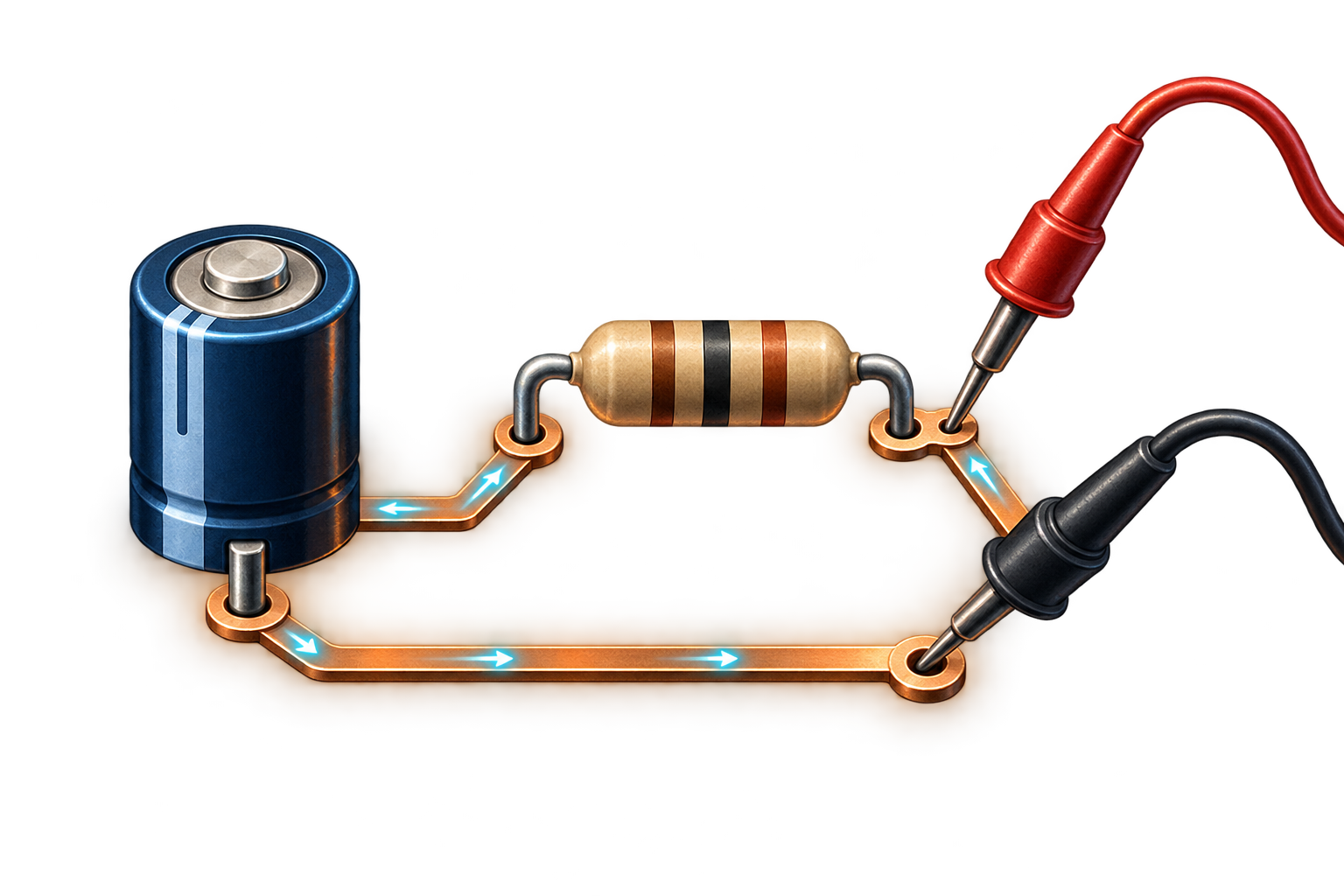
The relationship
For an ohmic resistor at a given temperature, the voltage across it, the current through it and its resistance obey Ohm’s law:
V = I × R · I = V / R · R = V / I
Use volts (V), amperes (A) and ohms (Ω). The voltage and current must refer to the same resistor. A resistance of 1 Ω allows 1 A when 1 V is applied across it.
Worked example
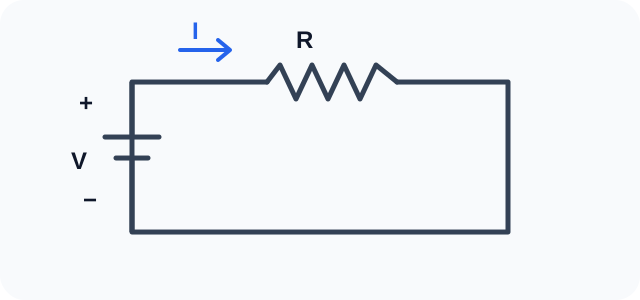
If 3.3 V is across a 330 Ω resistor, I = 3.3 V / 330 Ω = 0.010 A = 10 mA. The result is current through that resistor, not necessarily every branch of a larger circuit.
For a red LED with a 1.9 V forward drop on a 5 V supply at a target of 10 mA, the series resistor must drop 5 − 1.9 = 3.1 V. The theoretical value is R = 3.1 V / 0.010 A = 310 Ω. A common E12 value above that result is 330 Ω; the estimated current is 3.1 V / 330 Ω ≈ 9.4 mA. Real LED forward voltage varies, so this is an estimate.
Use the calculator
Try the related Ohm’s law calculator below with 3.3 V and 330 Ω. Check that it returns 10 mA, then change one value and predict the direction of the current change before calculating again.
Ohm’s law describes the resistor. A diode, transistor or other nonlinear component needs a model appropriate to its operating point.