UL 94 flammability ratings
Understand UL 94 HB, V-2, V-1, V-0, 5VB and 5VA ratings, the effect of thickness, and how to verify a material classification.
Written and technically reviewed byElectroDesignForge Engineering Team
View the editorial process📖 In brief
UL 94 classifies the flammability behaviour of a plastic material used in parts for devices and appliances. It is not a finished-product fire rating, a cable-installation rating, or a promise that a part cannot burn. The material, its exact formulation, its colour and its tested thickness all matter.
What UL 94 answers
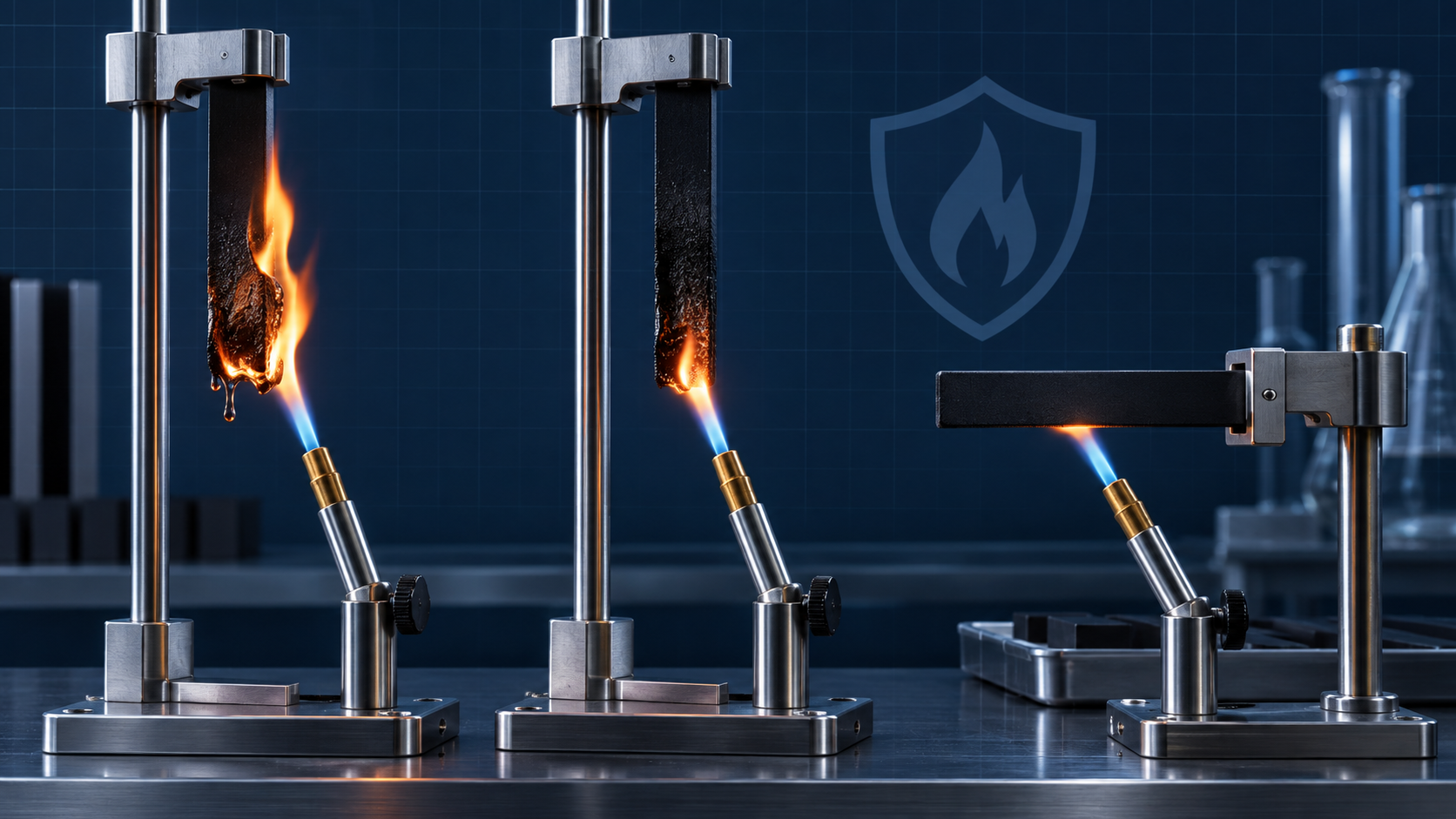
UL 94 uses controlled laboratory tests to compare how polymer specimens react to a small ignition source. Depending on the method, it evaluates burning rate, afterflame time, glowing combustion, whether burning material drips, and whether the specimen develops a hole.
It helps an engineer specify a polymer for a housing, connector body, insulation support, PCB-related plastic part or other component construction. The classification belongs to the tested material and thickness—not automatically to every part moulded from the same trade name.
| UL 94 can support | UL 94 does not establish |
|---|---|
| Selection of a plastic material for a component requirement | Fire resistance of an assembled product or installation |
| Comparison of specified material grades at stated thicknesses | Circuit operation during a fire |
| Limits on afterflame, glowing and flaming drips in the selected method | Smoke toxicity, smoke density or corrosion products |
| Evidence for a product standard that calls for a UL 94 class | A cable, plenum, building or fire-door rating |
The common ratings: HB, V-2, V-1 and V-0
The most frequently encountered UL 94 marks are HB and the vertical classes V-2, V-1 and V-0. They use different specimen orientations and criteria, so they are not simply a single linear scale.
| Rating | Test orientation | Practical reading |
|---|---|---|
| HB | Horizontal | The specimen must meet the method’s maximum burning-rate or burn-length requirement. It is commonly used for materials with limited horizontal burning behaviour. |
| V-2 | Vertical | The specimen must self-extinguish within the specified limits; flaming particles or drops that ignite the cotton indicator are permitted. |
| V-1 | Vertical | The specimen must meet stricter afterflame limits than V-2; flaming drops that ignite the cotton indicator are not permitted. |
| V-0 | Vertical | The most restrictive of these common vertical classes: tighter afterflame limits apply, and flaming drops that ignite the cotton indicator are not permitted. |
For the vertical test, a controlled flame is applied repeatedly to each specimen. UL 94 sets both per-application and cumulative limits. V-0 has the shortest allowed afterflame time among these three vertical classes. A V-2 material can still be self-extinguishing, but its permitted flaming drips can make it unsuitable near other combustible parts.
Do not write “V-0 is always better” without the product context: the required class, part thickness, ignition source, geometry and end-product standard determine what is appropriate.
5V: a more severe flame exposure
The 5V methods use a larger flame exposure than the common vertical V test. The resulting ratings are 5VB and 5VA.
| Rating | Key distinction |
|---|---|
| 5VB | The specimen meets the afterflame criteria, but a hole in the tested bar specimen may be permitted. |
| 5VA | The more demanding result: the tested bar specimen must not develop a hole under the method’s conditions. |
These classifications are useful where a product standard or component specification calls for resistance to the more severe 5V flame application. They still classify the tested material specimen; they do not certify the full enclosure, product or installation.
Thickness is part of the rating
A UL 94 result is never complete without its minimum qualifying thickness. A compound that is V-0 at 3.0 mm may have a different classification at 1.5 mm or 0.8 mm. The same caution applies to colour, additives, reinforcements, recycled content and processing conditions where these are not covered by the material’s recognition.
When a drawing requires, for example, “UL 94 V-0,” write the requirement in a verifiable form:
Material: [approved material grade]
Flammability: UL 94 V-0 at the minimum finished-wall thickness of [x] mm
Evidence: current material recognition / Yellow Card
The finished nominal wall must not be used alone. Include tolerances, weld lines, ribs, gates and the thinnest relevant moulded area in the design review.
How to read a material record
A supplier data sheet can be a useful starting point, but the authoritative evidence for a recognised material is its current UL material record, often called a Yellow Card. Check:
- Exact manufacturer and grade. A similar family name is not enough.
- Colour and reinforcement. Natural, black, coloured and glass-filled variants may be covered differently.
- Flammability class and minimum thickness. Read the value as one pair: class at thickness.
- Process form. Moulding, extrusion, film and foam can have separate coverage.
- Applicable component or end-product standard. The system-level requirement can impose further conditions.
If the evidence does not cover the exact material and minimum part thickness, treat the classification as unverified until the supplier, certifier or qualified test programme resolves it.
Common mistakes
| Mistake | Why it is wrong | Better practice |
|---|---|---|
| “The enclosure is V-0.” | UL 94 ordinarily classifies the material specimen, not the whole enclosure. | Name the material, class and qualifying thickness. |
| Copying a V-0 claim from a generic data sheet | The claim may apply only to a different grade, colour or thickness. | Verify the current material record for the exact variant. |
| Treating HB, V-2, V-1 and V-0 as identical tests | HB is horizontal; V classes are vertical and include different drip criteria. | Select the method and class required by the governing standard. |
| Ignoring a thin rib or wall | The thinnest critical region can fall below the qualifying thickness. | Review minimum manufactured wall thickness with tolerances. |
| Using UL 94 as an installation fire rating | It does not evaluate an assembled cable or building application. | Apply the product and installation standards separately. |
Quick checklist
- Identify the UL 94 class required by the governing product specification.
- Determine the minimum relevant finished-part thickness, including tolerances.
- Select an exact material grade recognised at that thickness.
- Check the supplier’s current UL material record for colour, reinforcement and process form.
- Keep the material evidence with the part’s compliance documentation.
Related references
- IEC protection classes I, II and III — distinguish electrical-shock protection from a plastic material’s flammability classification.
- IP protection rating — distinguish ingress protection from material flammability.
- Component temperature grades — assess the thermal limits of a component separately from its flammability class.