
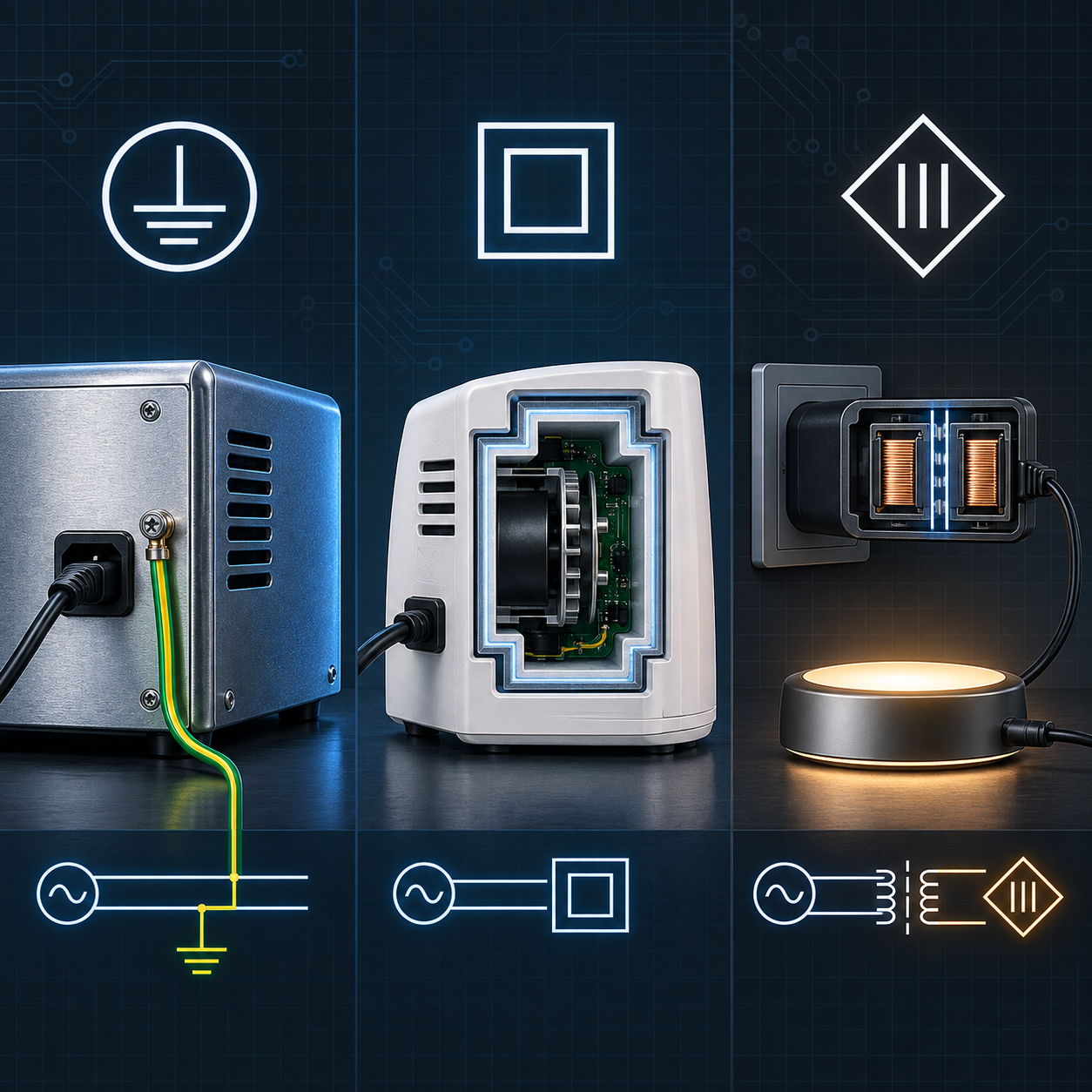
IEC protection classes I, II and III
Distinguish protective earthing, double insulation and SELV to select, connect and verify electrical equipment safely.
Written and technically reviewed byElectroDesignForge Engineering Team
View the editorial process📖 In brief
Protection classes describe how equipment protects a user against electric shock. Class I combines basic insulation with a protective conductor; Class II relies on double or reinforced insulation without a protective earth; Class III operates only from a safe extra-low-voltage (SELV) source. They do not describe an IP rating, electromagnetic compatibility, or an appliance’s power rating.
Why the Protection Class Matters
An insulation fault can make a metal enclosure, screw, shield, or housing accessible and dangerous. The protection class defines the second safeguard intended to prevent that fault from causing an electric shock.
It applies to the equipment as designed and connected. It does not replace installation requirements: overcurrent protection, automatic disconnection, equipotential bonding, residual-current protection, cable selection, and local wiring rules can still apply.
| Class | Protection principle under a fault | Protective earth (PE) | Typical example |
|---|---|---|---|
| I | Basic insulation + bonding of accessible conductive parts to PE | Yes, where an accessible part requires it | Mains-powered appliance with a metal enclosure |
| II | Double insulation or reinforced insulation | No | Charger, power tool, or insulated appliance marked with the double square |
| III | Supply exclusively from SELV | No, for shock protection | Luminaire or toy supplied by a SELV adapter |
The class of a product is established by its product standard and the manufacturer’s conformity assessment. Do not infer it solely from enclosure material, a two-pin plug, or a symbol seen on an accessory.
Class I: Insulation and a Protective Conductor
Class I equipment has basic insulation between live parts and accessible parts. Accessible conductive parts that could become dangerous under a fault are connected to the PE protective conductor.
In normal operation, PE is not intended to carry the load current. If a live conductor contacts the enclosure, fault current follows the intended protective path. The installation’s protective devices must then operate under the conditions required by the applicable rules.
What to check
- The cable, plug, outlet, terminal, and PE continuity must all be appropriate for the equipment.
- A protective-earth terminal is not the same as a functional ground, shield, or signal reference. They may be connected in a particular design, but their purposes differ.
- Never defeat PE by removing a pin, using an unsuitable adapter, or connecting the equipment to an unplanned two-wire supply.
- A plastic housing does not automatically rule out Class I: an accessible metal part or internal construction can still require PE.
The protective-earth symbol identifies a protective terminal or connection. By itself, it does not prove that an entire product is Class I; check the markings and documentation for the complete equipment.
Class II: Double Insulation, No Protective Earth
Class II equipment has supplementary insulation in addition to basic insulation, or reinforced insulation that provides equivalent protection. Its safety does not therefore rely on a PE conductor.
The Class II symbol consists of two concentric squares. It is commonly applied to double- or reinforced-insulated equipment, but must be used according to the relevant product standard.
What Class II does — and does not — mean
| Statement | Correct? | Why |
|---|---|---|
| “The equipment does not need a protective-earth wire for shock protection.” | Yes | Its second layer of protection is insulation. |
| “A Class II product can never have an accessible metal part.” | No | An accessible metal part is possible when the construction maintains the required clearances, barriers, and insulation. |
| “A PE can be added to any Class II product.” | No | Changing the connection or drilling the housing can compromise the certified construction. |
| “A two-pin plug proves Class II.” | No | A plug alone does not define an equipment protection class. |
Double or reinforced insulation is a system: insulating materials, clearance and creepage distances, barriers, assembly, moisture, pollution, ageing, and testing all contribute to its assessment. Adding a wire or replacing a cable without respecting the original construction can remove that protection.
Class III: Equipment Supplied from SELV
Class III equipment is designed to be supplied only from a safety extra-low voltage source, or SELV. Its shock protection relies on keeping the accessible circuit at a safe extra-low voltage and safely separating that circuit from mains.
The separation is commonly provided by a safety transformer or an appropriately isolated switched-mode power supply. The low-voltage device and its source form a safety chain: replacing the adapter with a non-compliant, incorrectly wired, or wrongly rated supply invalidates the safety assumption.
External-supply essentials
- Check output voltage, available current, AC or DC type, polarity, and connector required by the equipment.
- Confirm that the supply is specified as a SELV source for the relevant use and standard.
- Do not confuse a low operating voltage with SELV: a low voltage can still be referenced to a hazardous circuit or lose its isolation under a fault.
- Batteries and self-contained circuits can be Class III on the user side, but their mains charger must retain its own protection, often Class II or Class I.
The Class III symbol is a Roman III inside a diamond. As with other markings, it identifies the equipment to which it applies, not necessarily every item connected around it.
Do Not Confuse Protection Class, IP Rating, and Ground Types
These terms address different risks.
| Term | Question answered | Example |
|---|---|---|
| Class I, II, or III | How is electric shock prevented in normal operation and after an insulation fault? | PE, double insulation, or SELV |
| IP rating | How protected is the enclosure against access, solids, and water? | IP54, IP67 |
| Protective earth (PE) | Which conductor is intended to protect against electric shock? | Green/yellow conductor in many IEC systems |
| Functional earth / shield | Which reference supports function, EMC, or shielding? | Chassis, cable drain, RF reference |
An item can be Class II and IP65, or Class I and IP20: neither marking determines the other. Likewise, a shield bond can be necessary for EMC without being a protective conductor.
Selecting and Connecting Equipment Without Reducing Safety
For commercial products
- Use the cable, cord, and power supply specified by the manufacturer.
- Read the rating label and manual before substituting a supply or cord.
- For Class I equipment, verify the integrity of the PE path all the way to the supply outlet.
- For Class II equipment, do not replace a moulded cord, strain relief, or enclosure part with a non-equivalent component.
- For Class III equipment, use only the specified SELV source and do not open its mains power unit.
For electronic design
- Identify the applicable product standard before fixing the schematic, enclosure, and connectors.
- Define accessible parts, internal voltages, energy sources, and environmental conditions.
- Choose the protection strategy: PE and disconnection for Class I, an insulation system for Class II, or a genuinely isolated SELV interface for Class III.
- Size clearances, creepage distances, insulators, safety components, fuses, connectors, and return paths according to the product standard, surge category, altitude, pollution degree, and voltage.
- Plan the required tests: PE continuity, dielectric strength, touch current, heating, fault testing, and marking checks.
Do not mix these strategies without analysis: connecting a SELV output to mains, altering a Class II enclosure by adding metal, or using signal ground as PE are safety changes, not simple wiring adjustments.
Frequent Errors
| Error | Risk or confusion | Better practice |
|---|---|---|
| “Class II means there is no safety to check.” | Insulation can be damaged by repair, moisture, or modification. | Preserve the original enclosure, cable, and parts. |
| Disconnecting PE from Class I equipment to remove hum | Removes the planned fault path. | Solve the ground loop using a designed, safe solution. |
| Powering a SELV product with “any” low-voltage supply | Voltage, polarity, power, or isolation may be inadequate. | Use the specified SELV source. |
| Assuming IP67 implies shock protection | IP does not qualify the insulation scheme. | Verify IP rating and protection class independently. |
| Inferring class from the mains plug | The plug, cable, or accessory can be common to several constructions. | Read the equipment marking and documentation. |
Quick Checklist
- Find the class stated on the equipment or in its documentation.
- For Class I, check the complete PE path; do not use the equipment if that path is uncertain.
- For Class II, look for the double square and preserve all insulation and cable-retention parts.
- For Class III, verify the SELV supply, its output specifications, and suitability for the product.
- Check the IP rating, thermal limits, power rating, and product-standard requirements separately.
- Leave mains-related repairs or modifications to a qualified person, with the required tests after work.
Related References
- IP protection rating — distinguish protection against access, dust, and water from shock protection.
- MTBF versus service life — separate reliability requirements from electrical-safety requirements.