
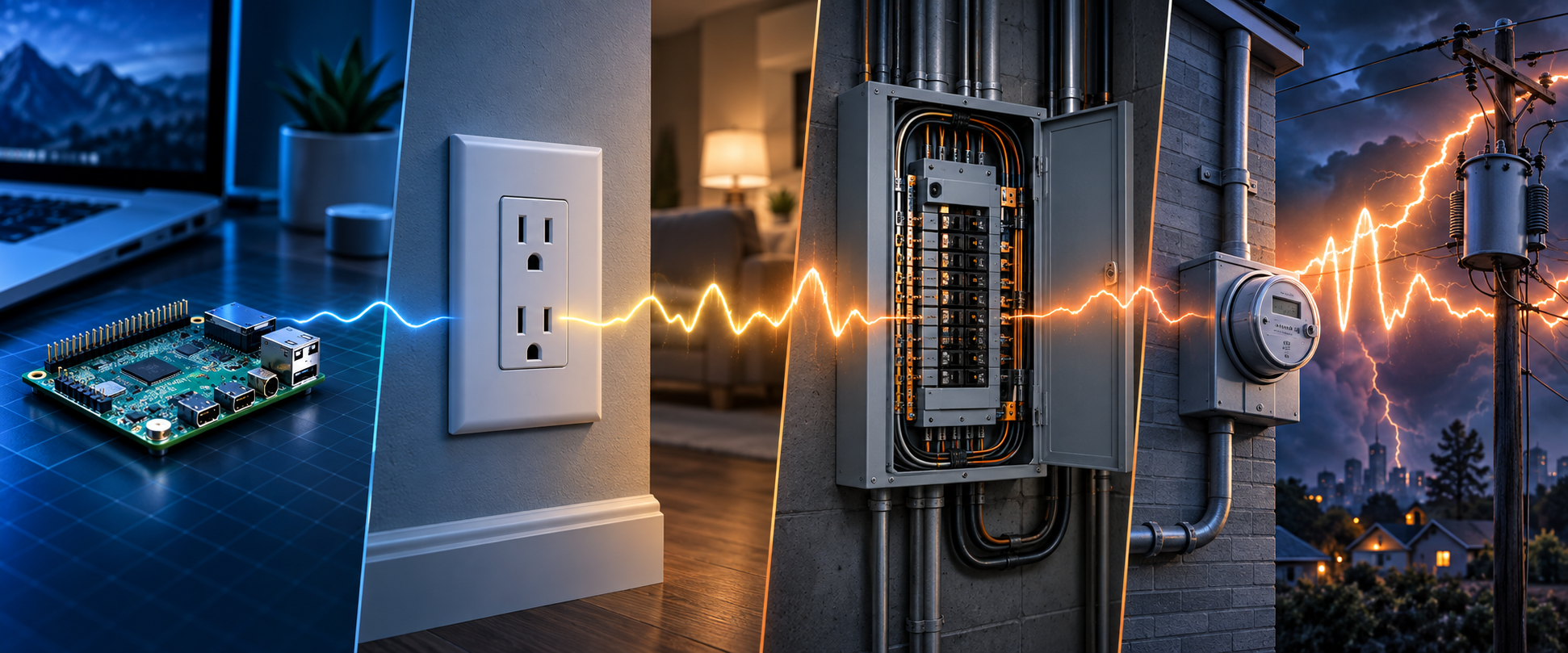
Overvoltage categories CAT I to CAT IV
Understand CAT I to CAT IV overvoltage categories, expected transient surges, and their impact on insulation, spacing, and equipment selection.
Written and technically reviewed byElectroDesignForge Engineering Team
View the editorial process📖 In brief
Overvoltage categories indicate the transient-surge environment a circuit can be exposed to in a low-voltage installation. From CAT I (well-protected circuits) to CAT IV (the origin of the installation and the outdoor network), the expected impulse amplitude and energy increase. They help define insulation, spacing, and equipment withstand level; they do not state operating voltage, IP rating, or electric-shock protection class.
What Are Overvoltage Categories For?
Inductive-load switching, grid faults, and lightning can inject very short impulses into an installation. A supply operating at 230 V RMS can still see a peak of several kilovolts for a few microseconds.
An overvoltage category — also called OVC — describes the electrical environment of a circuit and therefore the severity of transients its insulation must withstand. It is used notably by the IEC 60664 series for insulation coordination and by product standards such as IEC 61010 for measurement equipment.
It answers one question: which part of the installation is this equipment connected to? The closer it is to the energy origin, the higher the category.
| Category | Typical location | Transient exposure | Examples |
|---|---|---|---|
| CAT I | Circuit with limited surges | Low | Electronics supplied by an isolated supply or dedicated protection |
| CAT II | Utilization circuits fed by an outlet | Moderate | Household appliance, portable tool, or charger plugged into an outlet |
| CAT III | Fixed building distribution | High | Panel, circuit breaker, fixed wiring, or permanently connected motor/machine |
| CAT IV | Installation origin and outdoor network | Very high | Meter, service entrance, overhead line, or equipment at the connection point |
CAT I: Circuits with Controlled Transients
CAT I applies to circuits where measures limit transient overvoltages to a low level. This can include electronics behind an isolated power supply, transformer, filter, or appropriately selected protective device.
CAT I does not mean “safe in every respect”: operating voltage, available energy, internal faults, and the product-standard requirements still matter. It only means that the circuit is not assumed to receive the surges directly present on a building installation.
Careful examples include:
- a SELV input on a board supplied by a compliant mains adapter;
- secondary electronics behind correctly designed isolation;
- a signal circuit with transient protection whose clamp level is established for its environment.
A board connected through a long cable to outdoors, a motor, or a communication line is not automatically CAT I: the cable can import surges, and its protection interface must be assessed.
CAT II: Outlet-Fed Equipment
CAT II covers utilization circuits connected to mains through a plug, socket, or cord. These products remain exposed to switching events propagating through the installation, but are downstream of the building’s fixed distribution.
Typical examples include household appliances, portable tools, chargers, and many instruments connected to a wall outlet. For a measurement instrument, a CAT II marking defines the portion of the installation where its inputs may be used under the manufacturer’s stated conditions.
Using a mains plug alone does not prove CAT II: a product standard may define the limits differently, and the complete supply path — cord, extension, protection, and installation — must remain appropriate for the intended use.
CAT III: Fixed Distribution and Permanently Connected Loads
CAT III applies to a building’s fixed distribution and equipment connected directly to it. Transients are more severe than at a utilization outlet because conductors are closer to disturbance sources and available fault energy.
Common examples include:
- distribution panels, circuit breakers, and branch circuits;
- fixed wiring, junction boxes, and industrial outlets;
- motors, pumps, machinery, and lighting connected permanently;
- terminals downstream of a panel in a building installation.
A CAT III multimeter does not become suitable for a CAT IV measurement merely because its probes can physically reach the service entrance. The manufacturer’s category marking must cover the actual measurement point, together with rated voltage, fuses, and accessories.
CAT IV: Installation Origin and Outdoor Networks
CAT IV describes the most exposed environment: the origin of a low-voltage installation and conductors that can be directly influenced by the outdoor utility network. Its transients have the greatest expected energy and need the highest withstand level.
Relevant locations commonly include:
- the service entrance and utility connection point;
- meter equipment and conductors between meter and main panel;
- overhead lines, outdoor cables, and some feeders to separate buildings;
- protection or measurement equipment placed at that origin.
CAT IV is not an interchangeable marketing label. It must apply to the complete equipment, leads, and accessories, for a stated rated voltage and the relevant standard.
Typical Values for a 230/400 V Installation
Insulation coordination uses standardized impulse withstand voltages. For a typical 230/400 V installation, the values below are commonly encountered reference points for rated impulse withstand voltage; the exact table depends on the system, rated voltage, product standard, and applicable edition.
| Category | Indicative impulse voltage | Practical interpretation |
|---|---|---|
| CAT I | 1.5 kV | Protected electronics, not directly exposed to the installation |
| CAT II | 2.5 kV | Equipment plugged into an outlet |
| CAT III | 4 kV | Fixed distribution and permanent loads |
| CAT IV | 6 kV | Installation origin and outdoor network |
These numbers do not replace the table in the applicable standard. The same mains voltage can fall under different categories depending on where the circuit is installed. Conversely, a category does not by itself set the required spacings: pollution degree, insulating material, altitude, operating voltage, and topology also matter.
Overvoltage Category, Rated Voltage, and Pollution Degree
Three parameters are often confused although they describe different phenomena.
| Parameter | What it describes | Design consequence |
|---|---|---|
| Rated / operating voltage | Expected AC or DC level during normal operation | Working constraints, components, and basic insulation voltage |
| Overvoltage category | Severity of transient impulses arriving from the network | Impulse withstand voltage and air clearances |
| Pollution degree | Contamination that can make an insulating surface conductive | Creepage distances and material selection |
For example, CAT III equipment at 230 V in a polluted environment can demand a much more stringent insulation design than a CAT I circuit with the same nominal voltage in a clean, protected enclosure.
Altitude also matters: air ionizes more easily at higher altitude, which can require greater clearances. The applicable standard sets correction rules and test conditions.
What It Means When Choosing a Measurement Instrument
Category markings on multimeters, clamp meters, and probes are especially important. Always read them with the stated maximum voltage: “CAT III 600 V” and “CAT III 1,000 V” do not authorize the same use.
Before measuring:
- Identify the point in the installation: outlet, panel, service entrance, or isolated secondary circuit.
- Select an instrument with a category at least equal to the measurement point, for the voltage involved.
- Confirm that leads, probes, clamps, and fuses have compatible ratings; the lowest-rated accessory limits the complete setup.
- Inspect insulation, finger guards, probe tips, and leads before use.
- Follow the measurement procedure and protective equipment required by local rules and risk assessment.
Do not measure at a panel or service entrance with an instrument intended only for outlets or electronic circuits. An incorrect category can expose the operator to an arc flash, ejected material, and fault energy that the enclosure, fuses, or leads were not designed to contain.
What It Means for Electronic Design
The selected category should be decided during product architecture, not added after PCB routing.
- Determine the equipment’s real connection point in the installation and cables that may import surges.
- Identify the applicable product standard before choosing isolators, transformer, connector, or PCB spacings.
- Coordinate surge protection: fuses, MOVs, spark gaps, TVS devices, and filters must be sized for their energy, residual voltage, and fault behavior.
- Check clearances, creepage distances, slots, PCB material, and altitude rules specified by the standard.
- Assess the complete product: a TVS alone does not turn a CAT II circuit into CAT III when insulation, enclosure, connectors, and testing do not follow.
Protective devices limit a surge, but have residual voltage and finite energy absorption. Their selection requires checking both the impulse scenario and normal grid conditions, including temporary overvoltages.
Frequent Errors
| Error | Why it is unsafe or inaccurate | Better practice |
|---|---|---|
| “CAT IV is always better than CAT II.” | The category has meaning only with voltage, standard, complete equipment, and real use. | Select the category that matches the connection point. |
| Confusing CAT with protection class I/II/III | They address different risks. | Separate transient surges, electric-shock protection, and IP rating. |
| Assuming low voltage means CAT I | An outdoor cable can bring surges into a low-voltage circuit. | Assess interfaces and cable paths. |
| Using probes rated below the multimeter | The setup’s safety is limited by its lowest-rated accessory. | Check markings on every item. |
| Sizing insulation only from RMS voltage | Impulses and pollution degree also affect insulation. | Apply the product-standard and IEC 60664 tables. |
Quick Checklist
- Locate the circuit in the installation: protected, outlet, fixed distribution, or utility entrance.
- Select the corresponding category from CAT I to CAT IV, including external cables.
- Pair it with the exact rated voltage and environmental pollution degree.
- For a measurement instrument, check the meter, probes, leads, and fuses.
- For a product, apply its safety standard before finalizing the PCB and enclosure.
- Have mains-related designs and work reviewed and tested by a qualified person.
Related References
- IEC protection classes I, II and III — distinguish electric-shock protection strategy from transient-surge severity.
- IP protection rating — understand why ingress and access protection do not define an overvoltage category.