
Direct current and alternating current: amplitude, frequency, phase, and RMS
Distinguish DC and AC, read amplitude, frequency, period, phase, peak, and peak-to-peak, then relate them to RMS values and real measurements.
Written and technically reviewed byElectroDesignForge Engineering Team
View the editorial processKey point: direct current (DC) keeps the same polarity; alternating current (AC) reverses sign over time. An AC voltage is not described by “its volts” alone: state the waveform and whether the value is RMS, peak, or peak-to-peak.
DC and AC: the essential distinction
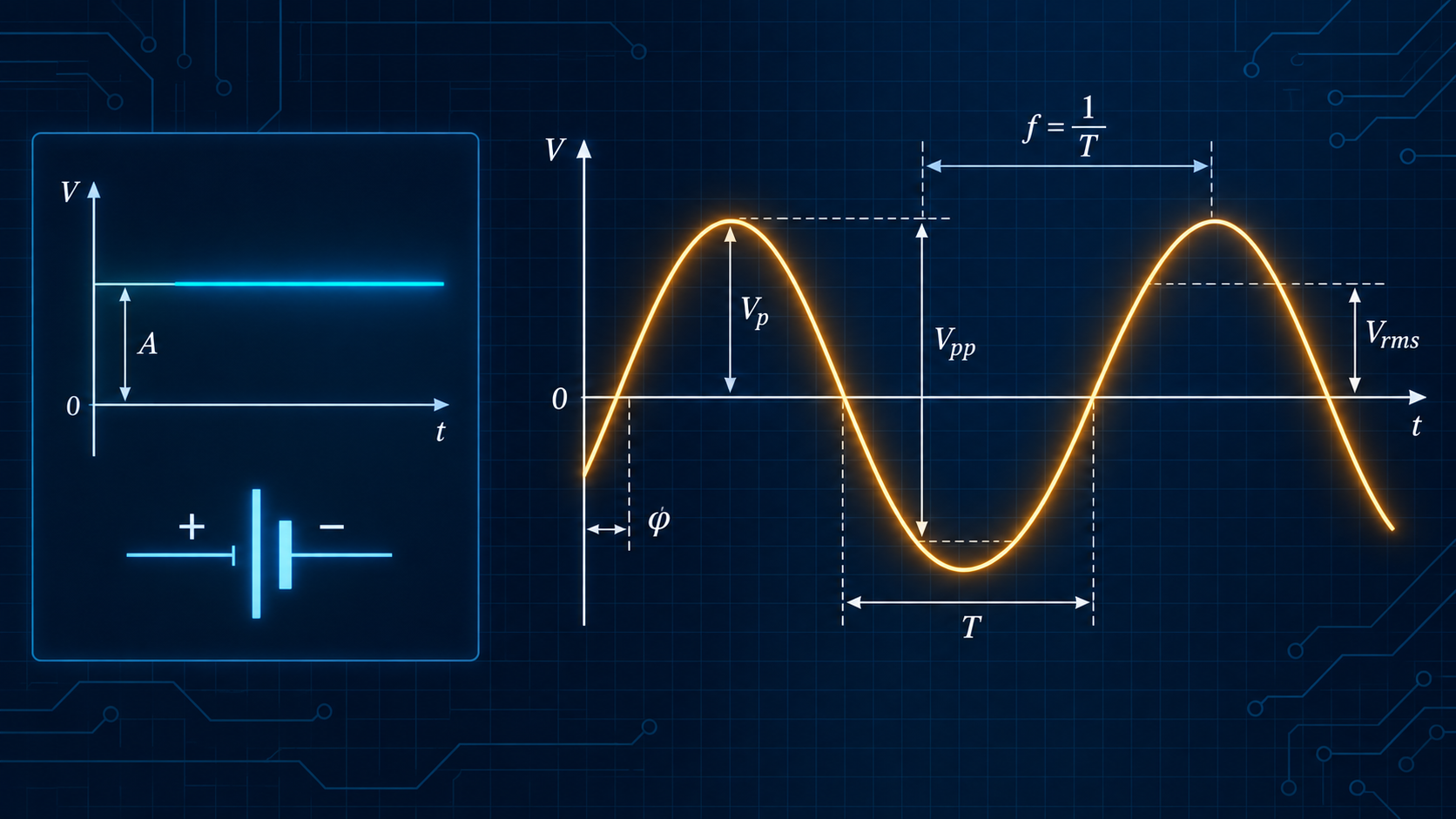
An ideal DC quantity has a constant value and polarity. A 9 V battery, for example, has fixed positive and negative terminals. Conventional current therefore travels in one direction. A practical DC supply can contain ripple, but its average component remains non-zero.
An AC quantity changes over time and repeatedly moves above and below its reference level. European mains supply is commonly 230 V RMS at 50 Hz; 230 V is neither a peak nor a peak-to-peak value. For an ideal sine wave, the peak is about 325 V and the peak-to-peak value about 650 V.
| Quantity | Direct current (DC) | Alternating current (AC) |
|---|---|---|
| Polarity | fixed | reverses periodically |
| Frequency | 0 Hz for a strictly constant value | non-zero for a periodic signal |
| Examples | battery, 3.3 V rail, 24 V bus | mains, audio output, RF signal |
| Useful measurement | average value and ripple | RMS, frequency, waveform, and distortion |
The vocabulary below applies to voltage, current, sound pressure, and other periodic quantities. The symbol changes: use V for voltage and I for current.
Amplitude, peak, and peak-to-peak
Amplitude is the greatest displacement between a reference level and the top of the waveform. For a sine wave centered on zero, it equals the peak value Vpk:
Vpk = amplitude
The peak-to-peak value Vpp is the difference between the positive maximum and negative minimum. For a symmetric sine wave:
Vpp = 2 × Vpk
Mind the offset: a waveform from 1 V to 5 V has Vpp = 4 V, an amplitude of 2 V about its midpoint, and an average level of 3 V. Its amplitude is therefore not necessarily its peak measured from 0 V.
| Ideal sine wave | Expression | Example for 230 V RMS |
|---|---|---|
| RMS | Vrms | 230 V |
| Peak | Vpk = √2 × Vrms | 325.3 V |
| Peak-to-peak | Vpp = 2√2 × Vrms | 650.5 V |
On an oscilloscope, Vpp is often the most direct reading because it does not depend on the chosen vertical zero. For insulation or maximum-voltage ratings, however, consider peak voltage and transient surges—not only nominal RMS.
Frequency and period
The period T is the duration of one complete cycle: the signal returns to the same state with the same slope. Frequency f is the number of cycles per second, in hertz (Hz). They are reciprocal:
f = 1 / T
T = 1 / f
| Frequency | Period | Example |
|---|---|---|
| 50 Hz | 20 ms | mains in most of Europe |
| 60 Hz | 16.67 ms | mains in North America |
| 1 kHz | 1 ms | reference audio tone |
| 1 MHz | 1 µs | clock or radio signal |
Frequency does not define shape. A 1 kHz sine, square, and triangle wave have the same period, but not the same RMS value for the same peak, nor the same harmonic content.
Phase: relative position of two signals
Phase states where a waveform lies within its cycle, usually relative to another waveform of the same frequency. One cycle is 360° or 2π radians. With a time delay Δt between two sine waves of the same frequency, phase shift is:
φ = 360° × Δt / T
A quarter-period shift is 90°. In a purely resistive circuit, voltage and current are in phase. With an inductor or capacitor, one can lead or lag the other. Phase matters for AC power, filters, and synchronisation; a phase comparison between different frequencies has no stable meaning.
RMS: the effective value that links AC to power
The RMS (root mean square) value is the square root of the average of the waveform squared over one period:
Vrms = √((1/T) × ∫₀ᵀ v(t)² dt)
It captures heating in a resistor. A 10 V RMS voltage supplies the same average power to a resistance as 10 V DC:
P = Vrms² / R = Irms² × R
For a pure sine wave:
Vrms = Vpk / √2 = Vpp / (2√2)
These ratios are not universal. A symmetric square wave has Vrms = Vpk, while a triangular wave has Vrms = Vpk / √3. For an arbitrary waveform, use the RMS definition or a true-RMS instrument within its specified bandwidth.
| Zero-centred waveform | RMS / peak relationship |
|---|---|
| Sine | Vrms = Vpk / √2 |
| Square | Vrms = Vpk |
| Triangle | Vrms = Vpk / √3 |
Use the RMS converter to quickly convert between RMS, peak, and peak-to-peak values for the selected waveform.
Measuring correctly in practice
Before recording a value, verify what the instrument displays. A basic AC multimeter may be average responding and calibrated for sine waves, making it inaccurate on a switched-mode supply or distorted waveform. A true-RMS meter calculates effective value more faithfully, provided crest factor, bandwidth, and allowed voltage remain within specification.
- Oscilloscope: check probe ratio (×1 or ×10), AC/DC coupling, vertical scale, and bandwidth. Read
Vpp, period, and offset; the scope may also calculate RMS. - Multimeter: choose the right DC or AC mode and know whether AC mode excludes DC. “AC+DC RMS” is not always the same as AC-only RMS.
- Mains: direct measurement is hazardous. Use probes and instruments appropriate for the voltage, installation, and overvoltage category.
Common pitfalls
- Saying “230 V” without RMS. In a mains context, it normally means 230 V RMS; its peak is higher.
- Applying
√2to every waveform. That ratio only applies to a pure sine wave. - Confusing amplitude with Vpp. For a centred sine,
Vppis twice amplitude. - Ignoring DC offset. A small AC ripple can ride on a high DC level.
- Comparing phase at different frequencies. The phase difference then changes continuously.